China has one of the world’s most established eyewear manufacturing supply chains, offering brands access to acetate, TR90, metal frames, lenses, components and custom production.
But successful eyewear sourcing from China depends on more than finding a supplier with the right price.
Many problems in mass production actually begin much earlier—during sampling, specification confirmation or quality planning.
Here are five common sourcing mistakes eyewear brands should avoid.
1. Approving a Design Without Proper Sampling
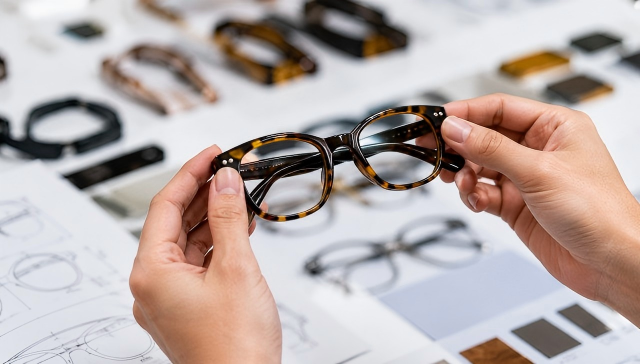
A drawing or product photo cannot fully show how a finished frame will fit, feel or perform.
Physical samples allow brands to check important details such as:
- Frame dimensions and proportions
- Material and color
- Hinge feel
- Temple alignment
- Surface finishing
- Lens fitting
- Logo position
If changes are required, they should be made during sampling rather than after mass production begins.
The final approved sample should become a clear reference for production.
2. Choosing a Supplier Based Only on Price
Two eyewear quotations can look similar while representing very different products.
Differences may include material quality, hinges, plating, polishing, lens specifications, production tolerances and quality-control requirements.
A lower price is not necessarily a problem—but brands should understand what is included in the quotation before comparing suppliers.
The better question is not simply:
“Who has the lowest price?”
It is:
“Are we comparing the same product specification and quality standard?”
3. Not Defining Quality Standards Before Production
“Good quality” means different things to different buyers and manufacturers.
Important requirements should therefore be discussed before production begins.
For eyewear, this may include:
- Color consistency
- Frame alignment
- Hinge opening and tension
- Polishing and surface finishing
- Logo position
- Lens specifications
- Packaging requirements
Clear standards reduce subjective decisions during final inspection and give both sides a shared reference.

4. Poor Communication During Development
Many production problems are not caused by manufacturing alone. They can start with an unclear specification or an unconfirmed change.
If a brand changes a color, dimension, hinge, logo or lens specification, the updated requirement should be clearly recorded and confirmed.
This becomes especially important when several models and colors are being developed at the same time.
Clear communication during development is one of the simplest ways to reduce production mistakes later.
5. Treating Final Inspection as the Only Quality Control
Quality control should not begin when finished eyewear reaches the packing table.
Material preparation, machining, assembly, polishing, alignment and finishing can all affect the final product.
Finding a problem during production usually makes it easier to correct before it affects the entire order.
That is why reliable eyewear manufacturing requires both in-process quality control and final inspection.

Building a More Reliable Eyewear Supply Chain
Sourcing eyewear from China does not need to be complicated.
The key is to establish clear specifications, review physical samples, define quality expectations and maintain consistent communication before and during production.
At Timing Optical, we support eyewear brands through product development, sampling, manufacturing and quality control, helping turn approved specifications into more consistent mass production.
Looking for an eyewear manufacturing partner in China?
Discuss your project with us or explore our eyewear collections.